E-invoicing and Peppol: what are the requirements?
Anyone emailing an invoice as a PDF often thinks they are invoicing electronically. They are not, and over the coming years that difference will cost time and money for anyone who misses it. An e-invoice is not a document but a file of structured data, made to be read by software. Below you will find what that means, what Peppol and UBL are, where it is already required and what you can do now.
Why a PDF by email is not an e-invoice
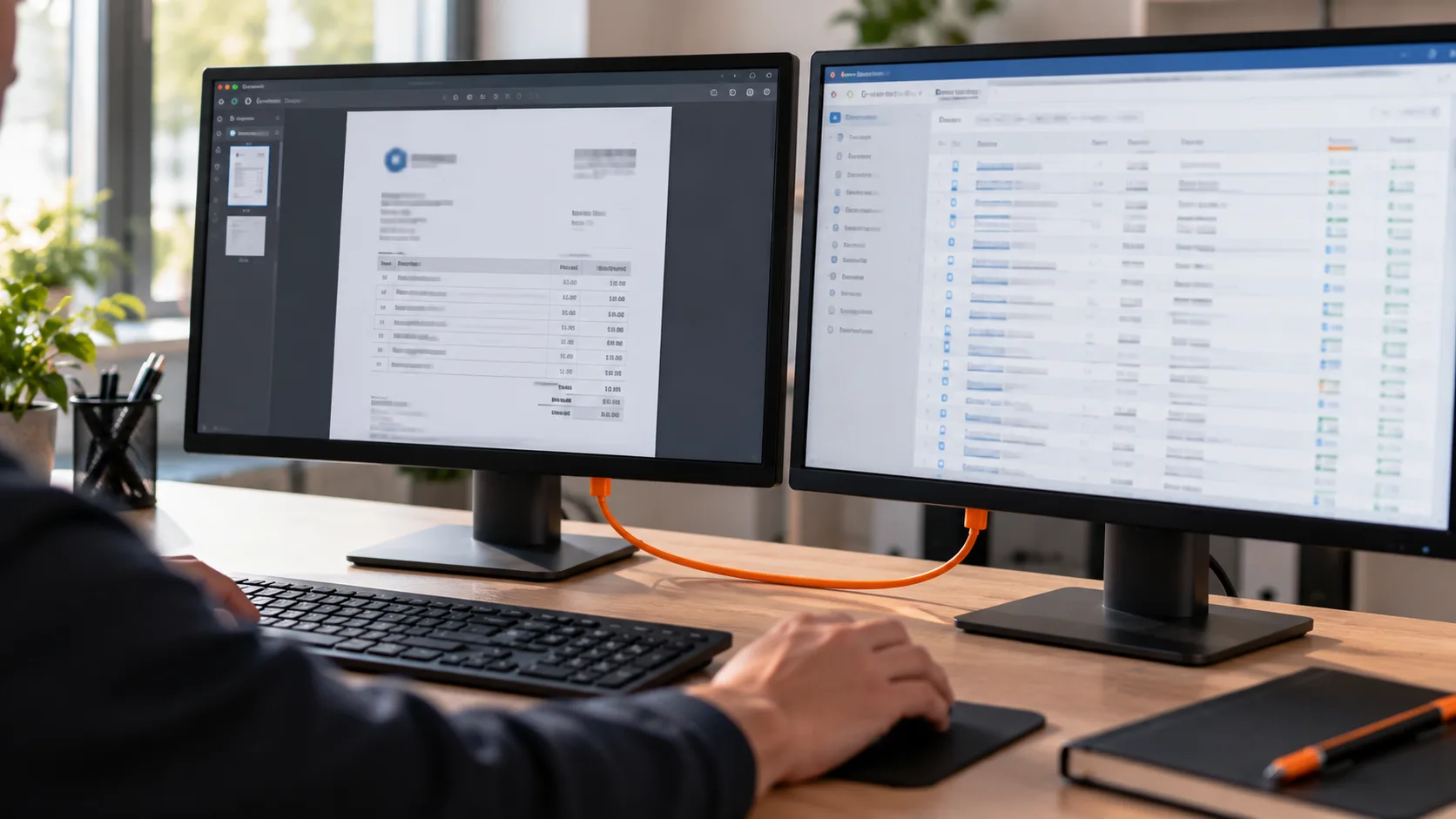
A PDF is a picture of an invoice. A person sees an amount, a date and a VAT rate on it, but to your client's software it is a block of layout with nothing to extract without retyping or scanning. That holds even if you laid it out neatly and even if there is a barcode on it.
An e-invoice is the opposite: a file in which every detail has its own field. The invoice number sits in the field for the invoice number, the VAT rate in the field for the VAT rate. Your recipient's accounting software reads that straight in, without anyone looking at it.
You see the practical consequence at payment time. A PDF has to be retyped at the other end or run through a scanning program, and that is where errors and delays come from. An e-invoice is sitting in your client's system ready for approval within seconds.
What are Peppol and UBL, and what is the difference?
UBL is the FORMAT: the agreement on what the file looks like and which fields belong in it. The European standard for it is EN 16931, and the profile used in the Netherlands and most EU countries is Peppol BIS Billing 3.0. So that is simply a file, which you can create, store and forward.
Peppol is the NETWORK: the route by which that file reaches your client. You do not send directly but through an access point, and your client receives through their own access point. Compare it with email: UBL is the message, Peppol is the postal system around it.
Those two are often confused, and that matters when comparing software. A package that says it creates e-invoices may only create the file. Sending through Peppol requires an accredited access point with a contract and a certificate, and that is a separate step. So always ask: does the package create the file, or does it also send?
Where is e-invoicing already mandatory?
In the Netherlands it has applied for years to suppliers of central government: contracts with the Dutch state have to be invoiced electronically. If you supply a ministry, a government agency or increasingly a municipality or a province, you will run into it.
Larger business clients also ask for it of their own accord. A contractor working for a housing association or a large installation firm will at some point be asked to deliver through Peppol, without any law behind it. That is often the moment a small business encounters it for the first time.
Beyond that, more European countries are making it mandatory step by step for business-to-business trade, and European plans are running to widen that. Those dates shift and differ per country, so for your own situation always check what applies right now rather than going by a year you read somewhere.
Which details have to be in an e-invoice?
The same ones that belong on any invoice, but stricter. The standard requires, among other things: an invoice number, the invoice date, the currency, the supplier's VAT number, name and address of both parties, a description with amount and VAT rate per line, and the corresponding totals.
The difference with a paper invoice is that there is no negotiating. If the VAT number is missing, the receiving software rejects the file, and there is no person who will read it correctly anyway. That makes it an immediate test of your own records: whatever is missing from your ordinary invoices is exposed here at once.
Watch your company identification as well. The number by which you are recognised hangs off the COUNTRY: in the Netherlands that is the Chamber of Commerce number with its own scheme code, in Belgium or Germany a different number with a different code. Software that hard-codes that sends a Belgian company out into the world claiming it is registered with the Dutch Chamber of Commerce.
What can you do now?
First make sure your ordinary invoicing is in order: a sequential invoice number without gaps, a complete VAT number, full address details for your client, and lines with a clear description and a rate. That is not extra work for e-invoicing, that is the work. Anyone with that in order can produce an e-invoice; anyone without it gets stuck on the first attempt.
Then ask your software supplier whether they can create the file to EN 16931 or Peppol BIS Billing 3.0, and whether they can also send. If they can only create the file, that is fine to start with: you download it and hand it to your client or to a Peppol service provider. Sending then becomes a matter of supplying that file, not of starting over.
And think about retention. The e-invoice is the original, not the PDF you keep alongside it for yourself. The file falls under the same retention obligation as the rest of your records, so make sure you can find it and that it stays readable, even when you switch package in a few years.
Frequently asked questions
Is an invoice sent as a PDF by email an e-invoice?
No. A PDF is an image of an invoice, meant for a person. An e-invoice is a file with structured fields that the recipient's software reads in directly, without retyping or scanning.
What is the difference between Peppol and UBL?
UBL is the format of the file, following the European standard EN 16931 and in practice the Peppol BIS Billing 3.0 profile. Peppol is the network that carries that file to your client, through access points on both sides. Compare it with a message and the postal system around it.
Do I have to send e-invoices yet?
If you supply Dutch central government, it already applies. Larger business clients often ask for it of their own accord. More European countries are making it mandatory step by step for business trade; the dates differ per country and shift, so check what currently applies to your situation.
This article is general information, not tax or legal advice. When in doubt, consult an adviser; rules can change.
More on these topics
More from this category
- Choosing quote software: what should you look for?A quote in Word takes time and sometimes goes wrong. This article explains where quote software makes the difference and how to choose well.
- Comparing invoicing software for freelancers: what to look forAll invoicing software promises the same thing: faster invoicing. These criteria help you truly compare freelance software, beyond the price tag.
- Creating an invoice: the legal requirements in the NetherlandsWhat details must appear on a Dutch invoice by law? VAT number, invoice number and more explained, with common mistakes and their consequences.