Scanning receipts: from till slip to books that add up
A hardware store receipt in your pocket is not bookkeeping. Only once it has been captured, attached to an expense and made findable does it count towards your VAT deduction and the Dutch retention obligation. Below you will find how to scan receipts so that they actually do, when the paper can go, and which mistakes leave a receipt worthless after the fact.
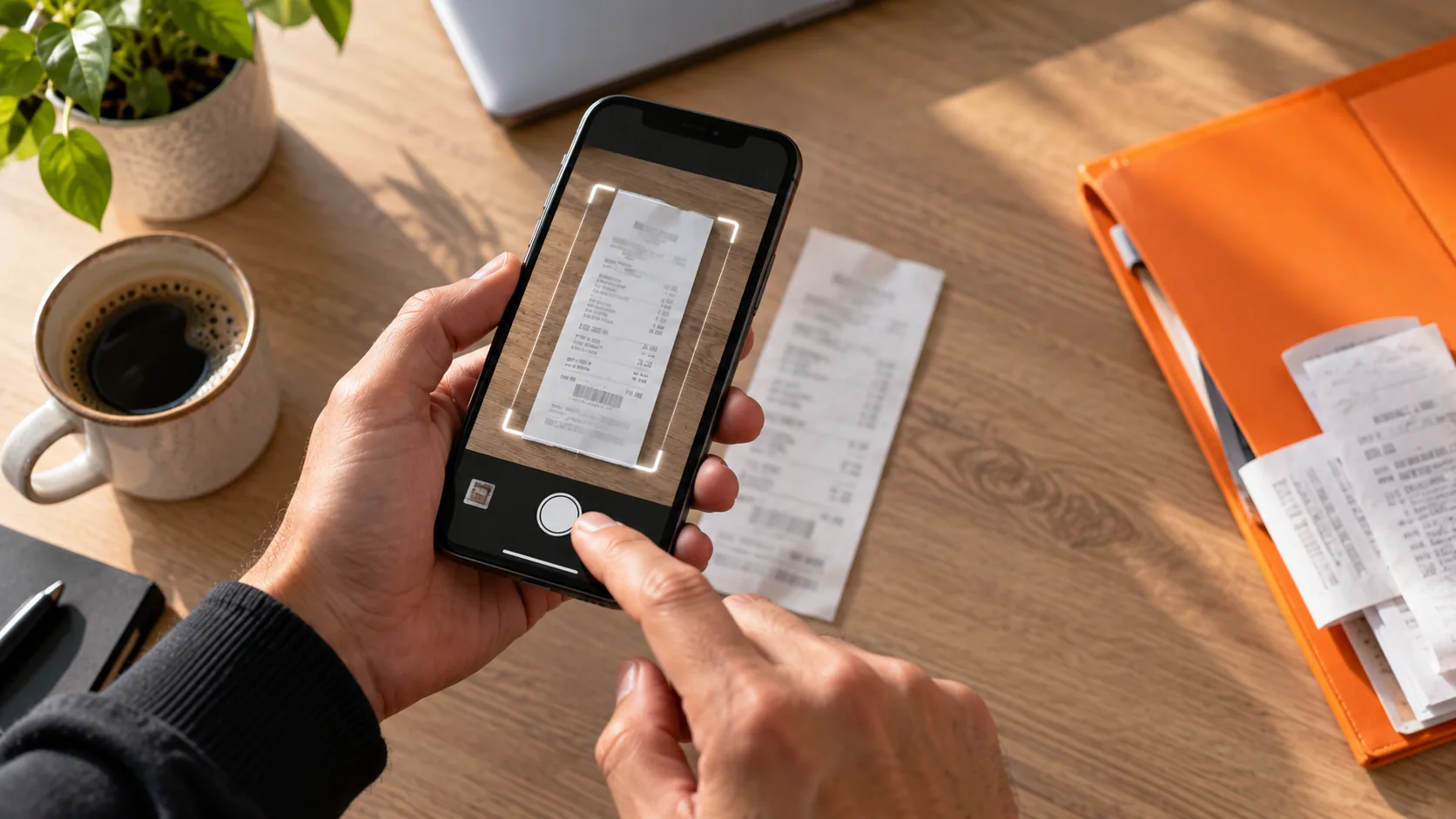
Why a photo of a receipt is not yet bookkeeping
Capturing a receipt is more than photographing it. To count, it has to be clear what was bought, when, from whom, for what amount and at which VAT rate, and those details have to hang off a booking. A folder full of photos on your phone does not meet that: you have the image, but nothing attached to it.
The practical difference only shows at the return. Anyone with a hundred loose photos has to type them over one by one and look up the VAT rate on each. Anyone who linked them to a supplier, an amount and a rate while scanning only has to check.
There is also a difference between a till slip and an invoice. For small amounts the Dutch tax authority accepts a simplified invoice, which needs fewer details. Above that threshold it has to be a full invoice, carrying your name as the buyer. So ask for one explicitly on a larger purchase, because a till slip without your details is not enough there.
What has to be legible on the scan?
The date, the supplier's name, a description of what you bought, the amount and the VAT amount or rate. If the VAT amount is missing you cannot reclaim it, however clear the rest of the receipt may be. So check that before you throw the slip away, not at the moment of filing.
Thermal paper is the biggest risk here. Till slips from many shops fade within months, certainly when they lie in a warm van or in the sun. That means the scan often becomes the only legible version you still have, so make it straight away rather than at the end of the quarter.
Scan the whole receipt, including the bottom with the total and the VAT breakdown. Half a receipt with a sharp top and the total out of frame is not evidence. Shoot straight down, on an even surface, without the shadow of your own hand across it.
Can the paper receipt go after scanning?
Digital retention is allowed, provided the scanned version is a faithful representation of the original and stays legible and accessible for the entire retention period. Meet that and the paper can in principle go. The retention obligation itself still applies; only the form changes.
Faithful representation means, in practice: complete, legible, and not altered afterwards. A scan where half the lines drop out or where you can no longer read the amount is not a faithful representation, and then the original remains the evidence. So check your scans for legibility before you clear out.
There are documents for which the original does have to be kept, for instance certain notarial deeds. That does not apply to ordinary purchase receipts, but if you are unsure about a specific document, put that question to your bookkeeper instead of binning it. Throwing away is the one step you cannot undo.
How do you get a receipt onto the right booking?
The link is where it usually goes wrong. A scan that ends up in a separate folder and is never attached to an expense does not surface at the return, and then you miss the deduction while you do hold the evidence. So record the supplier and the amount while scanning.
In a team it most often goes wrong with receipts picked up on the road. An engineer collecting materials holds the receipt at the moment they stand at the till, and never again back at the office. So have the receipt captured at that moment, from the phone, rather than in an envelope at the end of the week.
Watch out for double bookings as well. The same expense often arrives twice: once as a receipt and once through the bank statements. Without a link between the two the cost sits in your books twice, and you only notice when the figures stop adding up.
Which mistakes cost the most afterwards?
The first is the faded receipt. Anyone who leaves thermal paper lying for months and only scans it then is left with a grey patch. The expense has been made, but the VAT can no longer be reclaimed because there is no legible evidence left.
The second is the till slip without your details on a larger purchase. Above the threshold for a simplified invoice, your business has to appear on the document as the buyer. You ask for that at the moment of purchase, because getting an invoice in your name from a hardware store afterwards is a good deal harder.
The third is the private expense booked as a business one. A receipt carrying both materials for a job and groceries for home is not a business receipt; split it, or have the till produce two receipts. In an audit a mixed receipt is exactly the sort of thing that raises questions about the rest of your records.
Frequently asked questions
Can I throw away my paper receipts after scanning them?
Yes, if the scan is a faithful representation of the original and stays legible and accessible for the entire retention period. The retention obligation still applies; only the form changes. Check the scan for legibility before you clear out, because throwing away cannot be undone.
What has to be on a receipt to reclaim the VAT?
The date, the supplier, a description, the amount and the VAT amount or rate. If the VAT amount is missing you cannot reclaim it. On larger purchases there also has to be a full invoice, carrying your business as the buyer.
Why do till slips fade, and what do you do about it?
Many till slips are printed on thermal paper, which fades within months, certainly in a warm van or in the sun. So scan the receipt straight away rather than at the end of the quarter; the scan is often the only version that stays legible over time.
This article is general information, not tax or legal advice. When in doubt, consult an adviser; rules can change.
More on these topics
More from this category
- Delivery notes: what is the difference with an invoice?What is a delivery note, what does it show, and why can you not reclaim VAT on it? The difference with an invoice, and how to keep track of delivery notes.
- Multilingual staff and the books: how do you keep control?Does your team work in several languages? Read how to keep the books in one place and by Dutch rules, without confusion caused by language.
- Bookkeeping in your own language: the language barrier in adminDutch bookkeeping rules are already tricky, let alone in a foreign language. Read what mistakes this causes and how a multilingual interface helps.