Multiple trade names under one sole proprietorship: how does it work?
Yes, a sole proprietorship (eenmanszaak) can have multiple trade names (handelsnamen). You can only have one eenmanszaak, but under it you may run as many names and activities as you like, and adding a trade name with the Chamber of Commerce (KVK) is free. All names fall under the same KVK number, the same VAT number and one tax return. Below you will find how to register an extra name, what has to be on your invoices and where bookkeeping often goes wrong.
Can a sole proprietorship have multiple trade names?
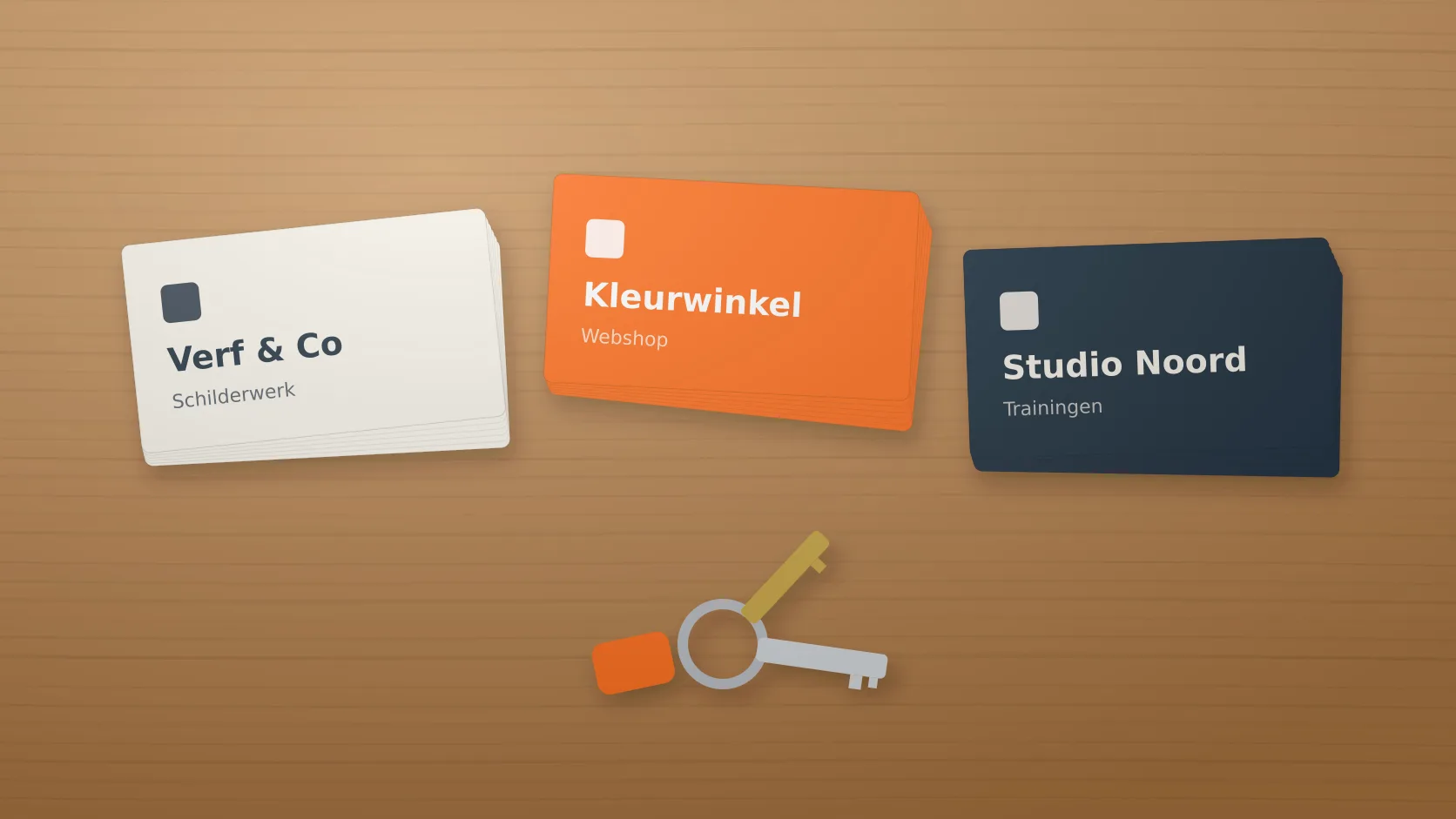
Yes. According to the KVK, you can have at most one eenmanszaak, but that eenmanszaak may have several trade names and several activities. A painter who also starts a webshop selling paint, or a photographer who also gives training courses, does not need to set up a second business: you add a trade name and an activity to the eenmanszaak you already have.
A trade name is the name under which you present yourself to the outside world: on your website, your van, your quotes and your invoices. It is not a separate business. Legally it remains one enterprise with one owner, and that is you.
So registering a second eenmanszaak is not possible. If you want two genuinely separate businesses, each with its own liability and its own tax obligations, you end up with a different legal form, such as a bv for each activity.
How do you add an extra trade name with the KVK?
You report an extra trade name via Mijn KVK, using your registration in the Business Register (Handelsregister). Adding or changing a trade name is free. If the new name also means a new type of work, report the business activity as well, because it partly determines which SBI code you are listed under.
You decide how many trade names you register: according to the KVK you may have as many as you need. That applies to an eenmanszaak and to a bv. After your change the KVK passes it on to the Belastingdienst itself; you do not have to report it separately. If you want the new name at the top of your extract, change the order with form 18. The statutory name of a bv is something else: you can only change it through a notary.
Check beforehand whether the name is available. The Trade Name Act (Handelsnaamwet) prohibits a name that resembles an existing name so closely that customers could confuse the two, especially in the same sector and region. The KVK will register your name, but it does not protect you against a conflict with another business; if necessary, you resolve that yourself or through the courts.
If you use the new name at a different address, for example a shop next to your workshop, you may need to register a branch (nevenvestiging) there. If you work from the same address, the trade name alone is enough.
What does it mean for your invoice?
On an invoice you state the trade name under which you did the work. The KVK number and the VAT identification number (btw-identificatienummer) are the same for all trade names, because they belong to the eenmanszaak and not to the name. The other mandatory details stay the same: your address, the customer's details, the date, a description, the amount and a unique invoice number.
When it comes to invoice numbers, you can choose. One continuous series for all names together is the simplest. A separate series per trade name is also allowed, for example with its own prefix, as long as each number is used only once and each series runs on without gaps.
A separate logo and house style per trade name is not required, but it does make sense: a customer of your webshop does not need to see your painting company's letterhead. In that case, make sure the KVK number and VAT number are the same on every template.
VAT, the small business scheme and income tax
For the Dutch Tax Administration (Belastingdienst) there is one entrepreneur. You therefore file one VAT return (btw-aangifte) that includes the turnover and input VAT of all trade names together. A separate return per trade name does not exist.
The same applies to the small business scheme (kleineondernemersregeling, KOR). The KOR turnover threshold applies to your eenmanszaak as a whole, so the turnover of all your trade names is added together. Two names that each stay below the threshold can exceed it together.
In your income tax return, the profit from all your activities counts together as business profit (winst uit onderneming). The hours criterion (urencriterium) of 1,225 hours per year is also assessed over everything together: the hours for your webshop and for your painting work both count. A loss in one activity is automatically offset against the profit of the other, because it is one enterprise.
Your bookkeeping: one whole, but trackable per name
Because everything is one enterprise, your bookkeeping must ultimately add up to one VAT return and one profit calculation. If you keep separate records per trade name, add up the figures of all names for every return. Anyone who forgets this only declares part of their turnover.
If you do want to see per trade name what comes in and goes out, for example to know whether that webshop is worth it, label every invoice and every receipt with the name it belongs to. A separate business bank account per trade name is not mandatory, but it makes reconciling with the bank a lot clearer.
If one of the activities grows into something with its own risks or its own staff, that is the moment to look at a bv with an adviser. Then they really are two enterprises, each with its own bookkeeping, its own tax returns and its own KVK number.
Frequently asked questions
Can a sole proprietorship have multiple trade names?
Yes. You can only have one eenmanszaak, but it may operate under several trade names and activities. You add a trade name via Mijn KVK, and it is free.
Do you get a separate VAT number for each trade name?
No. The VAT identification number and the KVK number belong to the eenmanszaak and are the same for all your trade names. You also file one VAT return for all names together.
How many trade names can you have?
As many as you need. According to the KVK a business may register several trade names, including an eenmanszaak. The Trade Name Act (Handelsnaamwet) only protects a name once you actually use it, for example on your website or your invoices.
This article is general information, not tax or legal advice. When in doubt, consult an adviser; rules can change.
More on these topics
Who this applies to
- Business owners with multiple companies or trade namesYou run more than one company and you're tired of logging in separately for each one and adding up the figures by hand afterwards.
- Freelancers and sole tradersYou don't have time for admin between two jobs. You want to send an invoice and get back to work, without the VAT return catching up with you in the evening.
Work it out yourself
Also worth reading
More from this category
- Invoicing without a Chamber of Commerce number: when is it allowed?Can you send an invoice without a KvK number in the Netherlands? When registration becomes mandatory, what belongs on the invoice, and how VAT works.
- Starting as a freelancer in the Netherlands: full 2026 checklistEverything you need to arrange to start as a freelancer: KvK registration, VAT ID, business account, insurance, bookkeeping and your first invoice.
Sources
Tax content reviewed by: TelMaar Team